Most families don’t notice one ‘big moment’ They notice a handful of little moments. A missed meal. A repeated story. A near-fall Or even a home that feels slightly off. If that’s happening for you, you are not alone… and it may be time to consider some extra support before things turn urgent.
In-home support doesn’t have to mean “taking over” someone’s life. Often, starting small brings the biggest relief — for your parent and for you.
Quick note: If there’s immediate danger (serious fall, sudden confusion, chest pain, severe weakness), seek urgent medical help right away.
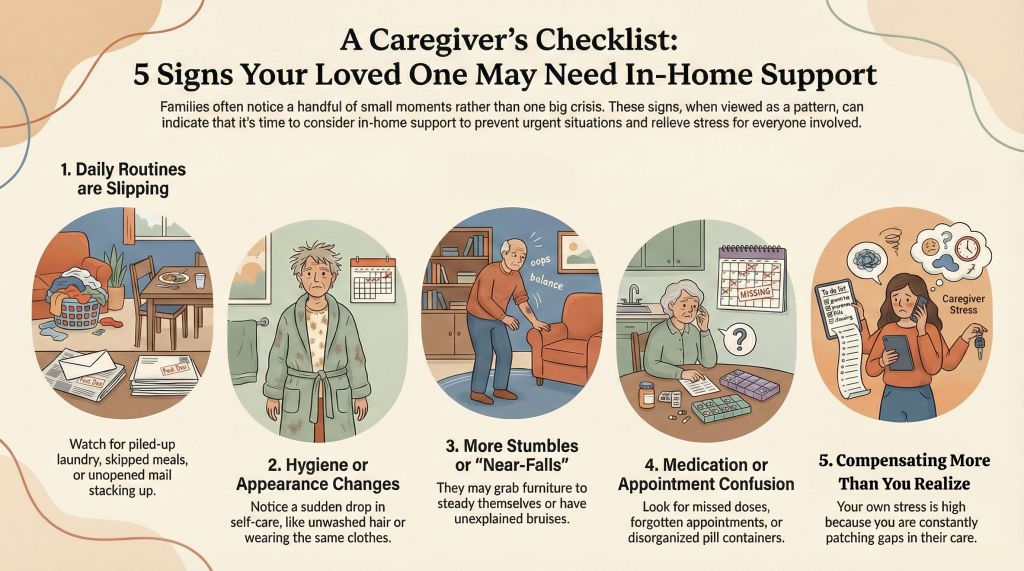
The 5 signs to watch for
These signs are easiest to spot when you look for patterns, not isolated moments.
Daily routines are slipping
Laundry piles up. Meals get skipped. The house feels “less like them.” Bills or mail start stacking.
What it can mean: Daily life is getting harder to manage (sometimes due to low energy, memory changes, pain, or mild depression).
What to watch: Is this occasional… or happening most weeks?
Hygiene or appearance changes
Same clothes more often, body odor, unwashed hair, or a sudden drop in self-care.
What it can mean: Tasks that used to be automatic now feel exhausting, unsafe, or overwhelming (especially bathing).
What to watch: Do they avoid bathing because they’re afraid of slipping? Do they seem embarrassed?
More stumbles, bruises, or “near-falls”
They’re grabbing furniture to steady themselves, moving slower, avoiding stairs, or limiting outings.
What it can mean: Balance and strength may be changing. Sometimes people quietly “shrink” their lives to reduce risk.
What to watch: New bruises, holding onto walls, reluctance to leave the house.
Medication or appointment confusion
Missed doses, doubled pills, forgotten appointments, or “I thought I already did that.”
What it can mean: Managing health tasks is getting complicated — and small mistakes can become big problems.
What to watch: Half-empty bottles, mixed pill organizers, repeated rescheduling.
You are compensating more than you realize
You’re calling multiple times a day, rearranging work, or feeling anxious because you’ve become the safety net.
What it can mean: Your loved one may be okay because you’re constantly patching gaps. That’s a sign your system needs support — not just your loved one.
What to watch: Your own stress level. If you feel “on alert” all the time, that matters.
What to do next (this week):
If you’re noticing 2+ signs, here’s a simple 7-day plan.
- Track patterns for 7 days:
Write down what you notice and when it happens. Keep it simple:
- What happened?
- What time of day?
- Any trigger (stairs, shower, missed meal, confusion)?
This helps you move from a feeling to a clear picture.
- Start a gentle conversation:
Try something non-threatening and practical:
- “I want home to feel easier and safer for you.”
- “Can we get a little extra help so you don’t have to do everything alone?”
- “Let’s try a small plan for two weeks and see how it feels.”
- Begin small (so life doesn’t feel “taken over”)
A few hours of companion support or respite can reduce stress quickly — without making it feel like a major life change.
Start small: what in-home support can look like
Here are real-life “starter” options families use:
- Companion support (a few hours/week): check-ins, meals/hydration prompts, light housekeeping, errands, and someone present so they’re not alone.
- Safety-focused help: support around stairs, getting in/out of chairs, and reducing fall risk during daily routines.
- Respite care for family: coverage so you can work, rest, travel, or simply stop feeling like you’re always on call.
And just to say it plainly: needing support doesn’t mean anyone failed. It means you’re responding early, wisely, and with care.
FAQs
Does getting help mean my parent is losing independence?
Not necessarily. Many people keep more independence longer when they have the right support at the right time.
What if my parent refuses help?
That’s common. Starting with “help around the house” or “a weekly companion visit” can feel more acceptable than framing it as “care.”
How many hours should we start with?
If you’re unsure, contact us with your city/county and what you’re noticing for a free assessment.
Is in-home support only for seniors?
No. Families use in-home support for many situations where routines, safety, or supervision have become harder.
What’s the first small change you noticed?
Serving Chattanooga and nearby areas including Hixson, East Ridge, Ooltewah, Signal Mountain, Ringgold, Middle Valley, Apison, and Graysville.
 Compassion Home Care
Leave a comment