
People often say “home care” like it’s one service. In real life, families are usually choosing between two different kinds of support and picking the right one can save stress (and money).
If you’re in the Chattanooga area and trying to figure out what fits, here’s a clear, plain-language guide.
The simple difference
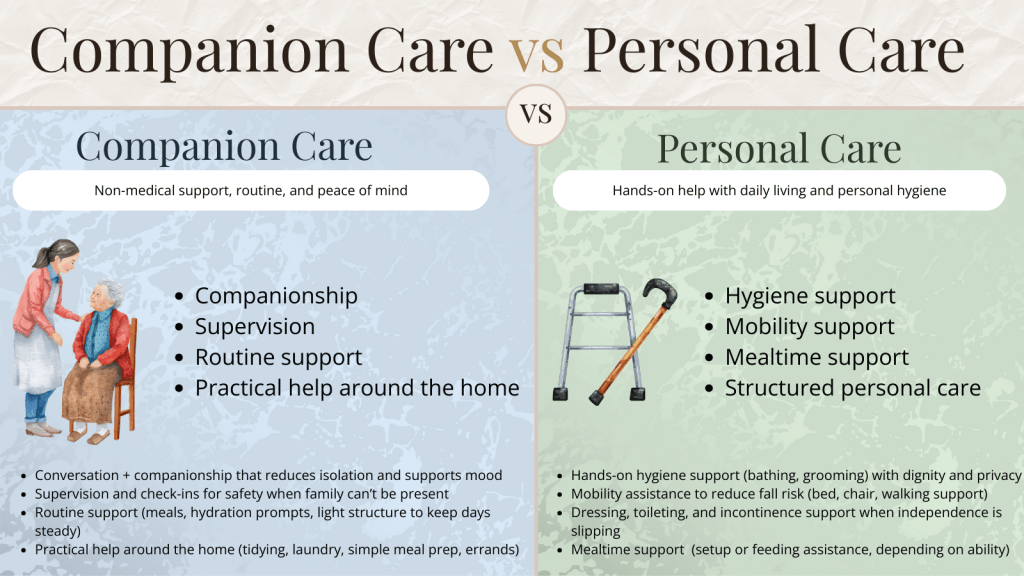
Companion care helps when someone is mostly independent, but shouldn’t be alone for long stretches — or needs help staying on track day to day. Personal care helps when someone needs hands-on physical assistance with everyday tasks (often called ADLs: Activities of Daily Living).
Companion care: presence, routine, and peace of mind
Companion care is a great fit when your loved one is safe enough physically, but you’re noticing things like loneliness, forgetfulness with routines, or long gaps where nobody is checking in.
Companion care often includes:
- Conversation and social connection (reduces isolation)
- Routine support (meals, hydration reminders, gentle structure)
- Light help tied to daily living (tidying, dishes, laundry, meal prep)
- Errands or accompaniment (if offered)
- Safety awareness (someone present to notice changes early)
Families usually choose companion care when they’re thinking:
- “I don’t want Mom alone all day.”
- “Dad is fine… but he’s not himself lately.”
- “She’s safe, but she’s slipping on routines.”
Personal care: hands-on help with daily living tasks
Personal care is for when your loved one can’t safely do certain tasks alone anymore — especially tasks involving balance, privacy, or strength.
Personal care often includes:
- Bathing and hygiene support
- Dressing and grooming
- Toileting assistance
- Mobility support / transfers (getting in/out of bed or a chair safely)
- Mealtime support (setup, feeding help if needed)
Families usually choose personal care when they’re noticing:
- Falls or near-falls
- Hygiene slipping
- Difficulty getting dressed
- Increasing fatigue, weakness, or unsteadiness
How to decide in 60 seconds (a practical rule)
Use this quick rule to choose a starting point:
- If the main issue is loneliness, supervision, or staying on routine → start with companion care.
- If the main issue is safety with the body (bathing, toileting, getting up/down) → you likely need personal care.
If you’re still unsure, don’t overthink it. Start with the smallest level of support that genuinely improves safety and stability, then adjust.
The part many families miss: it can be both
A lot of families begin with companion care (because “they shouldn’t be alone”), then add personal care later as needs change (without having to overhaul everything). That gradual approach is often the least disruptive and easiest to sustain.
Signs you may need personal care now (not later)
If you’re noticing any of these consistently, it’s worth considering personal care:
- Getting in/out of bed or chairs looks shaky
- Bathing is avoided, rushed, or “doesn’t seem to be happening”
- Clothes are frequently unchanged or mismatched for the weather
- Toileting accidents, urgency issues, or bathroom safety concerns
- New bruises, unexplained soreness, or “small falls” they minimize
- You’re worried about leaving them alone because of physical risk, not just loneliness
Questions to ask any home care provider (quick checklist)
Before you book services, ask:
- What’s the difference between companion and personal care in your agency?
- What tasks are included and what are not?
- How do you match caregivers (training, personality, availability)?
- How do you handle changes in needs over time?
- What does communication look like (updates to family, frequency, point of contact)?
- What’s the minimum schedule and can we scale up/down?
- If the plan changes, how quickly can we adjust the level of care?
FAQs
Is companion care the same as “sitting services”?
Sometimes. The core idea is presence + routine + supervision. The exact tasks depend on the agency and care plan.
Do I need personal care just because my loved one is older?
No. Age alone isn’t the deciding factor. Safety and ability with daily tasks is.
What if my loved one refuses help?
This is common. Often, starting with companion care feels less “medical” and more comfortable, and can open the door to more support later.
How fast can we start?
That depends on schedule and care needs. Many families begin with a short assessment call, then start with a modest plan and adjust.
Ready to talk it through?
If you tell us what you’re noticing, we’ll help you figure out what level of support fits without making it feel bigger than it needs to be.
Serving Chattanooga and nearby areas including Hixson, East Ridge, Ooltewah, Signal Mountain, Ringgold, Middle Valley, Apison, and Graysville.
 Compassion Home Care
Leave a comment